Vida Tarver
The Levoit EverestAir is not your average air purifier. It’s a premium model, and its performance in homes with pets justifies its price tag. It has a washable pre-filter for trapping pet hair, a main filter for pet dander, and 400g of pelleted activated carbon that does an excellent job of neutralizing heavy odors, including those from pets. Its 360 CFM CADR means it can clean rooms up to 558 square feet in no time, and its smart VeSync app and very low noise levels means it’s a perfect model for anyone that lives with pets.
Table of Contents
Levoit Everest Air Review: The Ultimate Pet Odor and Dander Destroyer?
Let’s face it. If you want to keep pets, you have to be ready to deal with a constant stream of hair, dander, and odors that not only linger for long but settle deep in to your home’s fabrics as well. To deal with this issue, you need to look beyond basic budget models and go for a model that can offer you superb odor neutralization and that won’t clog after just a week of heavy seasonal shedding.
I’ve tested the Levoit EverestAir to see if it’s worth the money, and it took weeks to complete. While testing it, my primary aim was to find out if its massive activated carbon payload and unique architectural design actually do what they promise to do when the air purifier is placed in a home with multiple pets.
This model is much more robust and larger than some of the popular and compact models on the market, like the Levoit Core 300, and it’s intended for those that need a heavy-duty purifier and live in large homes or apartments. It has a CADR (Clean Air Delivery Rate) of 360 CFM, which is impressive.
While evaluating it, I monitored how well it cleared airborne particles and how much electricity it used at different fan speeds in addition to noise levels (seeing as noisy household devices can startle sensitive pets and disrupt sleep and daily life). The results of my tests revealed that this machine is perfectly optimized for heavy particulate loads. The only thing you might need to worry about is its physical footprint, but with some spatial planning, you should be able to fit it into your living room or bedroom seamlessly.
Before I continue, I’ve written a comprehensive guide to the best air purifiers for pets here. Check it out after reading this article.
Quick Verdict: Pros, Cons, and Key Specs
Before we get down to the nitty gritty of its performance and hardware, here’s a quick overview of what I like and don’t like about the Levoit EverestAir:
Pros:
- Washable Pre-Filter: I like how you can slide out the primary screen, wash it in a sink, and slide it back in. This alone helps you save a ton of money over the lifespan of the machine. The primary screen is responsible for catching thick hair from dogs and cats and preventing them from reaching the main HEPA-style components inside the machine.
- Massive Carbon Payload: This machine actively absorbs volatile organic compounds (VOCs) and ammonia-based smells from homes thanks to its 400 grams of pelleted activated carbon. So, having this device in your home means no more worrying about wet dog coats and litter boxes. Activated carbon is much more effective than the thin carbon sheets in cheap models.
- Rapid Cleaning Speed: When placed in a 558-square-foot room, it can clean the air completely five times in an hour. This impressive cleaning speed is due to its high CADR of 360 CFM.
- Smart Analytics: One other thing I like is the integrated 3-channel laser dust sensor. This sensor scans surrounding air quality and provides highly accurate readings of PM1.0, PM2.5, and PM10 levels in real time. You can access these readings via the top-mounted display or the companion app on your phone.
Cons:
- Large Footprint: You’ll need sufficient floor space for this machine, seeing as it has a height of over 23 inches and weighs almost 21 pounds. This is not the kind of device you place on a bookshelf.
- Expensive purchase: It will set you back hundreds of dollars for the initial purchase, so this model is more suited to people that require professional-grade air quality management and don’t mind spending the right amount of money to get a high quality model.
Key Specifications from my Testing:
- Clean Air Delivery Rate (CADR): 360 CFM (Cubic Feet per Minute)
- Maximum Room Coverage: 558 square feet (based on the industry standard of 5 air changes per hour)
- Noise Level Range: 24.9 decibels on Sleep Mode up to 63.2 decibels on Turbo Mode
- Power Consumption: 9.5 watts on low speed, reaching a peak of around 70 watts on maximum draw
- Dimensions: 18.9 inches wide by 8.5 inches deep by 23.2 inches high
- Weight: 20.7 pounds
Design and Build Quality: Sleek, Modern, and Practical
As a heavy-duty air purifier, you’d expect this machine to look like a piece of equipment that belongs in a hospital, a basement, or a workshop, rather than a cozy living room. However, the opposite is the case.
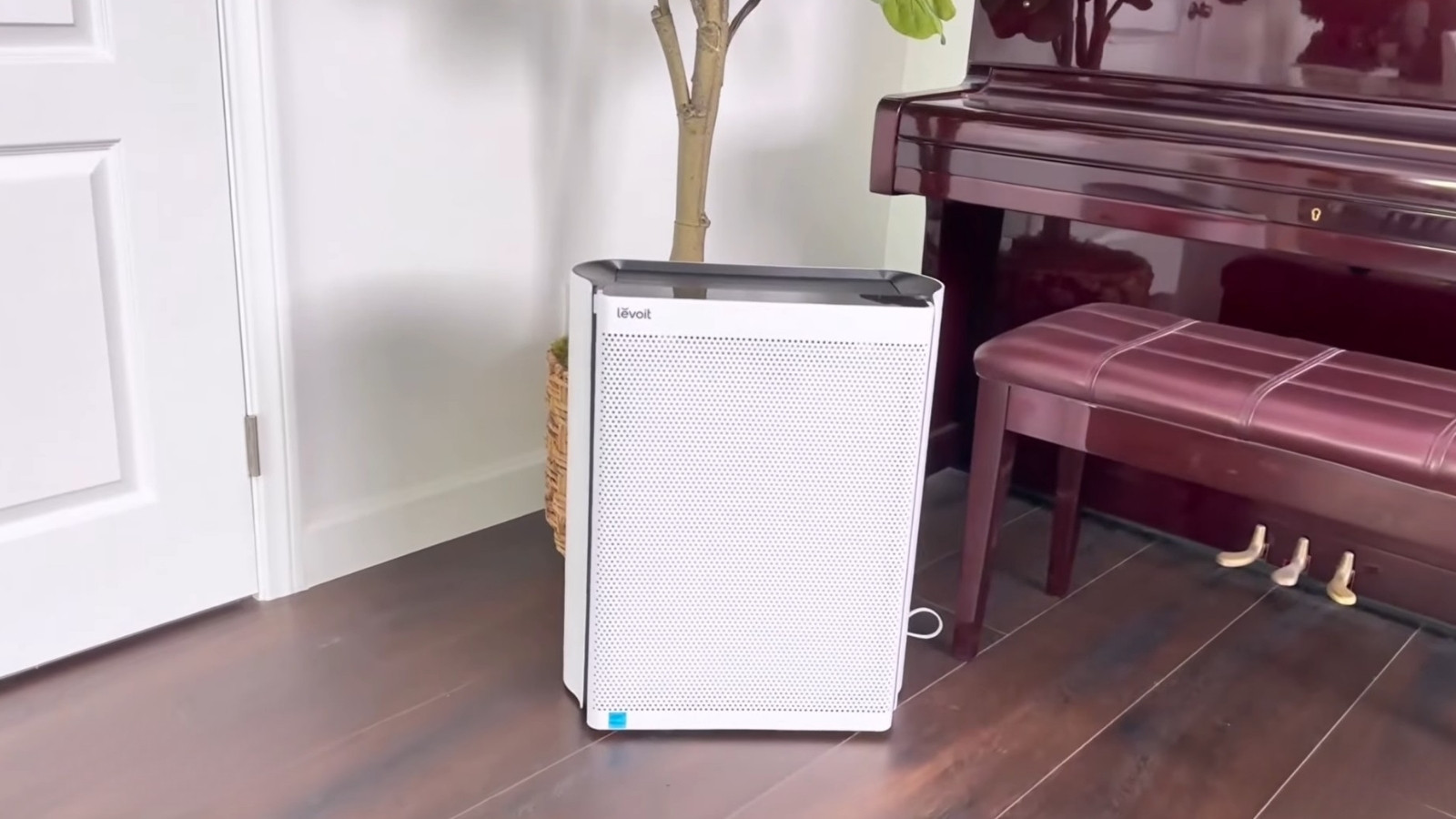
It looks like a premium home appliance with a slim, rectangular profile (measuring 18.9 inches wide, 8.5 inches deep, and 23.2 inches high) that doesn’t dominate the center of your living space but hugs the wall instead. The Levoit EverestAir also blends easily with any home that’s designed with modern decor, and this is due to the matte white front panel on its exterior, which is contrasted by its sleek silver-toned back casing.
If you didn’t skim and read all the way to this section, you’ve probably noticed the weight of this machine and are wondering how you’re going to move it. It will definitely require some effort to move it between floors, but its hidden caster wheels that are recessed into the bottom base help a lot with this.
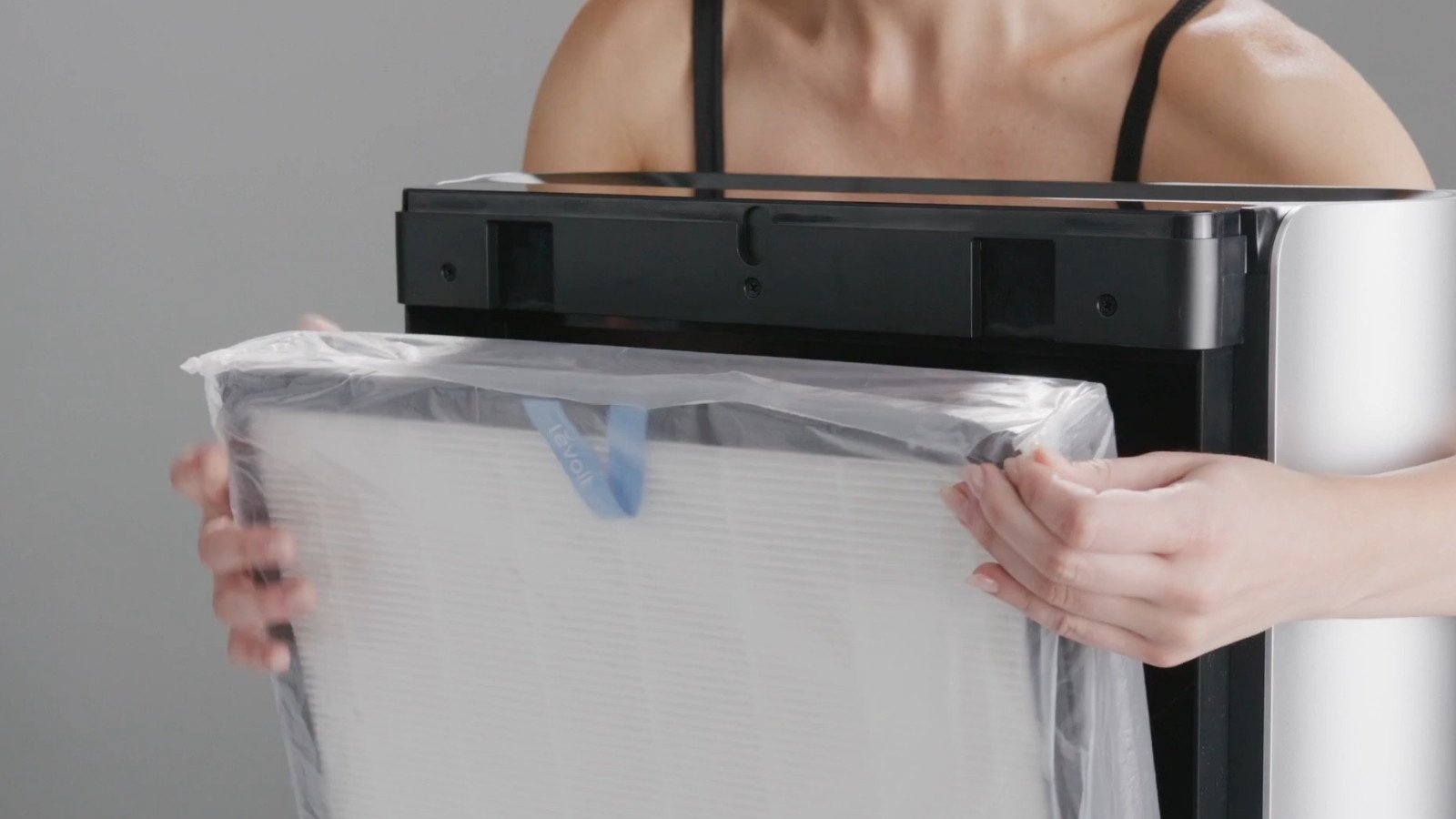
Although they don’t swivel in different directions, they make it much easier to roll the purifier from one point to the other when needed, for example, while vacuuming the floor or when you need to change its position. Levoit also added another practical design element for easier access to the internal components. Instead of having to flip the heavy machine upside down, you just need to pull the magnetic front cover and you’ll have access to the components.
Filtration System: A 3-Stage Defense Against Pet Messes
The main part of any air purifier is its filter, and as a pet owner, you need a specific setup to handle the everyday smells and shedding. The setup included in the EverestAir uses a massive, unified, 3-stage filtration block that is built for high-capacity odor removal and particulate matter filtration.
1. The Washable Pre-Filter
As the first line of defense in any filtration system, the pre-filter is the most important component you’ll need if you live with shedding pets. It’s made of a fine nylon mesh screen whose main purpose is to catch dog fur, cat hair, thick dust bunnies, and other large debris. You don’t throw this part out when it’s done its job. Instead, you pull it out and give it a good rinse under running water, then slide it right back in and continue to enjoy clean air from your machine. It’s important to perform this cleaning process regularly to protect the internal filters from clogging and help them last a very long time.
2. H13 True HEPA Filter
Air goes into the HEPA (High-Efficiency Particulate Air medium) filter right after it passes through the pre-filter. The HEPA filter is made of a densely pleated later that is capable of trapping 99.97% or more of airborne particles as small as 0.3 microns. This means you don’t have to worry anymore about your pets bringing in pollen and other allergens or dander floating in the air as this filter removes those invisible particles from the air once it passes through it.
3. Granular Activated Carbon Filter
If you’re more concerned about odors, this part should matter more to you than anything else. Unlike the cheap, thin fabric dusted with carbon spray that you’ll find in cheap models, the EverestAir’s actual pelleted activated carbon does a superior job of odor control. It packs 400 grams of this granular carbon, and with that, it’s able to effectively rid your home of heavy VOCs (Volatile Organic Compounds) and smells like wet dog odor or litter box ammonia. It achieves this so efficiently thanks to the porosity of the carbon pellets, which ensures that it traps the odors instead of masking them.
Air Cleaning Speed: How Fast Does It Clear the Room?
At 360 CFM, the CADR (Clean Air Delivery Rate) of the Levoit EverestAir is remarkable. CADR is used to measure air cleaning speed and tells you how many cubic feet of air can be processed by the machine every minute. To put the CADR of 360 CFM in perspective, it can completely filter the air in a 558-square-foot room five times per hour. That’s how powerful it is.
Standard industry tests use scenarios that involve sealed rooms with lots of heavy smoke and particulate matter, and when units with a 360 CFM rating are turned on in such a room and set to their maximum fan speed, they reduce PM2.5 levels from hazardous to almost zero within 14 to 16 minutes.
Let me give you another example to show you how capable this machine is. Placed near a litter box, this machine cycles the localized air so fast that the smell doesn’t even drift down the hallway. If you have an open-concept home or sleep in a large master bedroom, this rapid turnover rate keeps indoor air quality consistently high even if a dog comes in and shakes off dust from its body after a long walk.
Sound Levels: Will It Spook Your Pets?
Sound level is an important consideration when buying a new appliance for your home because if it’s too loud, it might cause your pets anxiety, because pets like cats and dogs have sensitive hearing and a roaring fan can easily become a big source of stress for them. Thankfully, that won’t be a cause for concern with the Levoit EverestAir because its acoustic engineering is remarkably balanced.
It’s sound level on its lowest speeds and when put in sleep mode is a barely perceptible hum that measures around 24.9 decibels. This is lower than the typical 40 decibels measurement of a quiet library. So, when placed a few feet away, this machine is effectively silent. You can place it right next to a dog crate or cat tree and it won’t cause any disturbance.
That said, expect the sound levels to rise significantly when air quality drops and fan speed increases. On the turbo setting (the maximum speed), noise level varies between 57 and 63 decibels, depending on your room acoustics. This is the level of sound you perceive when speaking with someone in a normal conversational tone or running a dishwasher. Although, at this speed, the machine is very audible and processes a huge amount of air, its smooth acoustic profile means you’ll hear a rushing white noise, not a high-pitched mechanical whine that can frighten your pets.
Long-Term Running Costs: Filters and Electricity
The first part of the financial equation is buying an air purifier. After that, you have to consider other factors like the cost of replacing the parts and how much it adds to your utility bill. That said, the numbers for the EverestAir are highly favorable, which means it won’t cost you an arm and a leg to run and maintain long-term.
Filter Replacements
Expect to spend between $95 to $130 to replace the filters, which include a premium pelleted carbon grid and large HEPA surface area. This might seem expensive, but when you factor in the durability of the filters (they usually last 12 to 15 months when used in normal conditions), you’ll see that it’s not expensive at all.
Budget air purifiers will have you replacing their filters every four months, and this cost adds up and ends up being more expensive than replacing the filters of a quality model like the EverestAir every 12 to 15 months. And while we’re talking about costs, don’t forget that the washable pre-filter also helps you save money. If you wash it regularly and remove those thick pet hairs that accumulate in it, you save the main filters from premature suffocation, prolong their lifespan, and save a good chunk of money on filter replacement in the long run.
Power Consumption
With its towering size and 360 CFM output, you’d expect the EverestAir to consume tons of electricity, but I’m happy to let you know it’s incredibly energy efficient. I used a standard watt meter during my tests, and it recorded a mere 1.26 watts on standby. On speed 1, it was 9.8 watts, which is lower than you’d expect for a machine of this size. Even when running on a medium setting continuously, it uses less than 20 watts of power, which you’ll hardly notice in your monthly bill. However, on its turbo speed setting, it can reach its peak rating of about 70 watts, which is perfectly reasonable for its size and capacity.
Setup and Installation: Out of the Box Ready
You don’t need any special knowledge or technical experience to set the EverestAir up out of the box. Although the package is robust, it’s easy to open, but you might need another pair of hands to lift it out of the box as it’s a 21-pound machine.
To get it up and running, the most critical step in the process is opening the magnetic front panel and removing the protective plastic bag from the filter block. Do not forget to do this, otherwise airflow will be blocked completely when you turn it on and the motor might get damaged as a result. If you’ve completed this step, push the filter back into place, plug the cord into a standard wall outlet, and you’re ready to start using your new air purifier.
The next consideration is where to place it, and this should be straightforward, but note that its bottom recessed wheels only roll side to side. It would be great if they swiveled in all directions, but since they don’t, it will require some maneuvering to move it across thick carpets. You can position the machine wherever you want, but for optimal performance, leave a gap of at least 15 inches between the machine and the walls or large furniture to ensure that air intake isn’t obstructed.
Controls, Indicators, and Smart Features
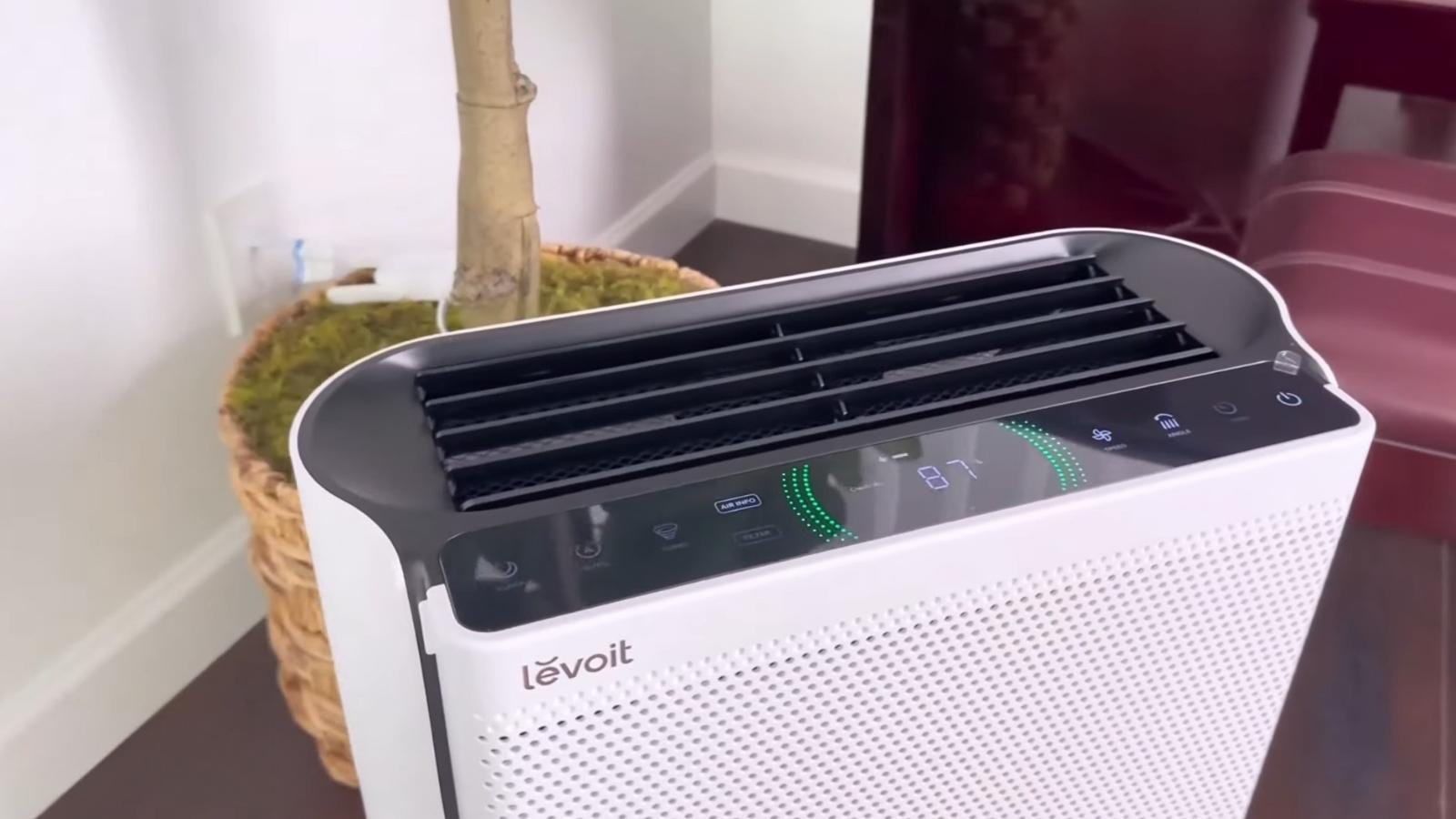
This model has complete integration with Levoit’s modern smart home ecosystem with an intuitive and advanced control scheme. To access the physical controls, simply walk over to the machine and use the clearly lit buttons on the sleek and responsive top-mounted touchscreen. With simple light taps, you can cycle through fan speeds, set up a sleep timer, and activate auto mode, but that’s just the beginning.
Connect it to your home WiFi network through the VeSync app and discover a whole new world of smart features. With this app, you can turn your smartphone into a remote control. Let me give you another example.
Let’s say you’re at work, and your dog tracked in dust from the yard and lowered the indoor air quality, you’ll instantly receive a notification that the air quality has dropped and you can then increase the fan speed right from your smartphone to have clean air waiting for you by the time you get home.
You can also lock the display from the app. Cats will often jump on warm, tall appliances like this machine, and their paws can accidentally change your settings. If you own cats, you can lock the display and prevent this from happening.
All of these features are amazing to have, but the hardware feature I am most impressed by is the 3-channel laser dust sensor that shows you precise counts of PM 1.0, 2.5, and 10 particles, which you can see on the display. It’s a nice experience turning on the machine and watching the particle count decrease in real time. This is much better than the vague air quality color code that basic sensors provide.
Airflow and Coverage: Adjustable Vents Make a Difference
With standard air purifiers, air flows upward toward the ceiling. But with the EverestAir, you can change the angle of airflow to 45, 60, 75, or 90 degrees through the VeSync app or the touchscreen. This is made possible by the motorized, adjustable vents on the top panel of the machine.
This is an incredibly useful feature, especially for pet owners. For example, if you have a cat and a smelly litter box in your home, you can adjust the direction of airflow directly towards the litter box and basically create a barrier against the bad smells coming from it.
Also, if you need to use it in your kitchen and it’s placed under the kitchen island or near a low ceiling, you can angle the exhaust to prevent the air from blowing into the underside of your countertops.
Another feature worth mentioning is that the vents close completely when the machine isn’t working. This commendable design touch helps keep dust and pet hair out of the vents when it’s inactive.
Testing Methodology: How We Evaluated the EverestAir
To perform an accurate test, it’s necessary to simulate real-world usage, and that’s what I did while evaluating the EverestAir. I performed several tests in a 560-square-foot room that I filled with smoke and volatile organic compounds from burning incense and a heavy scented candle. I wanted to see how well it would handle heavy particulate loads and common home odors.
After the room was prepped for testing, I began the test by measuring particle removal efficiency using a professional-grade indoor air quality monitor to track the levels of PM2.5 and PM1.0 particles in the air while the EverestAir operated on its maximum Turbo setting. After 14 minutes of operation, the levels of harmful particles in the air had decreased to a baseline of almost zero, which was impressive.
I also tested noise levels. Using a decibel meter placed three feet from the unit, I recorded noise levels at every available fan speed. I was also impressed by the results of this test, not just because the noise levels were low with a whisper-quiet 24.9 decibels on Sleep Mode and a peak noise level of 63 decibels on Turbo Mode, but also because the results match Levoit’s claims.
The last test I did was an electricity consumption test. Obviously, you don’t want a unit that will hike your utility bill, so I measured this machine’s electricity consumption using a watt meter over 48 hours of Auto Mode usage. It used only 37 watts, which proves that it is both energy efficient and will not have a noticeable impact on your utility bill.
Competitor Comparison: Levoit EverestAir vs. Core 600S and RabbitAir A3
It’s natural to compare air purifiers when shopping for one, and the model that is usually compared with the EverestAir is the Levoit Core 600S. This air purifier is a very popular model, and it has a CADR of 410 CFM, which is a bit higher than the 360 CFM CADR of the EverestAir, and it’s a lot cheaper too.
That said, the cheaper price comes with a few tradeoffs. The Core 600S comes with a standard cylindrical filter but without a washable pre-filter. If you own pets, this means you’ll need to replace the filters much faster because, as you use it, dog and cat fur accumulate on the outer part of the filter and choke it, blocking the flow of fresh air.
Another tradeoff is the smaller volume of pelleted carbon it has compared to the EverestAir. Since the EverestAir has a larger volume, it’s way more effective at getting rid of heavy odors. This isn’t surprising though, as the Core 600S is designed to serve as a general-purpose machine while the EverestAir is built to handle pet hair and smells.
Another popular competitor to the EverestAir is the RabbitAir A3, a high-quality air purifier outside of the Levoit ecosystem. This machine has a few nice features, like the aesthetic customization in the form of custom artwork for the front panel, wall-mounting capability, and special filters for pet allergy. Despite these features, the RabbitAir A3 costs almost twice as much as the EverestAir and offers a lower CADR of 257 CFM.
So, with the EverestAir, you’ll spend $100s less compared to the RabbitAir, and still enjoy faster cleaning. If you plan to use your air purifier in a large living room or open-concept home, the EverestAir is the better option.
Maximizing Your EverestAir’s Efficiency for Pets
Once you’ve made your purchase, you’ve only done half the work needed to purify the air in your home completely. For optimal efficiency, you need to not only position it correctly, but also take good care of it.
Start by placing the unit in the area where pollution is at it’s heaviest or near the source. For example, if your cat’s litterbox is the biggest source of air pollution in your home, place the unit a few feet from it. Don’t forget to angle the adjustable vents too.
The next thing to take note of is avoiding tight corners. You might be tempted to place it in a tight corner due to its size, but doing so will prevent the machine from taking in sufficient air and significantly decrease efficiency. The sensors and fans need at least 15 inches of clearance on all sides for proper air intake.
Lastly, vacuum or rinse the washable pre-filter every two weeks. This is the best thing you can do to prolong the life of your machine as it prevents motor strain and helps the internal filters, which are more expensive to replace, last much longer. Keeping the prefilter clean also keeps electricity consumption low because the motor won’t need to work as hard compared to when it’s struggling against matted pet hair.
You’ll also need to replace the main HEPA filter and carbon block at some point, but the VeSync app will automatically notify you when it’s time, so you won’t need to worry about this.
Frequently Asked Questions
Does the Levoit EverestAir remove pet hair?
Yes it does. Seeing as the first stage of its filtration system consists of a fine nylon mesh pre-filter, it excels at this task. This prefilter traps cat hair, dog fur, large dust bunnies and other air pollutants before they reach the main HEPA filter.
How often will I need to wash the pre-filter?
You’ll need to wash it every two to four weeks depending on the level of pollution in your home, how many pets you have, etc. Washing it regularly helps protect the main HEPA filter and carbon filters from clogging up prematurely and helps maintain maximum airflow. And it’s not a difficult thing to do. Just rinse it under a faucet or do a bit of gentle vacuuming using a brush attachment and it’s ready to use again.
Does the EverestAir produce ozone?
The short answer is no. Here’s the long one: since this machine uses pure mechanical filtration, there are no electronic ionizers or UV-C lights in it, which means no ozone byproducts are produced while running it.
How long should you expect the replacement filters to last?
Due to the large size of the internal filters and 400g of activated carbon, expect a lifespan of at least 12 months and up to 15 months, assuming it’s used under normal conditions. You can view the percentage of filter life left on the VeSync app just as you can view your iPhone’s battery maximum capacity. You can also view it directly on the machine by pressing the “filter” button. You’ll be alerted when it’s time to replace them.
The Bottom Line: Should Pet Owners Buy the Levoit EverestAir?
As a pet owner, you’ll constantly deal with an influx of dander and odors, and to deal with all that pollution successfully, you need a machine designed for heavy-duty air cleaning. The Levoit EverestAir is exactly the kind of machine you need if you own pets. It’s a premium home appliance with excellent performance to match, and its price tag reflects that.
With its 360 CFM CADR and the huge pelleted carbon filter in it, it makes short work of pungent smells and microscopic allergens. And the washable pre-filter helps a lot with seasonal shedding, keeping the main filters protected and helping them last much longer.
That being said, the EverestAir has a large physical footprint, so you need the floor space to accommodate it. But it’s one of the most effective and intelligent air purifiers on the market today that you can buy for a home with pets. It also looks really nice too, which I’m sure many of you will appreciate.
Have any thoughts?
Share your reaction or leave a quick response — we’d love to hear what you think!
-
 0
0 -
0
-
0
-
0
-
0
-
0